
Biliary Atresia in Babies: When to Suspect It and How Is It Treated?
Biliary atresia is one of the most common causes of neonatal cholestasis. The incidence varies between regions, with approximately 1 in 8,000–18,000 live births affected (AAP data). It is a serious liver disease that affects newborn babies. It occurs when the bile ducts, which normally carry bile from the liver to the intestine, are blocked which happens during perinatal period. As a result, bile cannot flow normally, leading to progressive jaundice and liver damage subsequently.
The good news is that early diagnosis and timely intervention can significantly improve outcomes. So, what should parents look out for, and when should a baby be evaluated? Here are some of the most common questions that parents ask me.
What is biliary atresia?
- Progressive fibro-inflammatory obliteration of the extra- and intrahepatic bile ducts that disrupts the flow of bile from the liver to the duodenum.
Biliary atresia is a condition in which the bile ducts outside the liver become progressively scarred and blocked. Bile then gets trapped inside the liver, causing jaundice and, over time, fibrosis and cirrhosis. It usually becomes apparent and symptomatic during the first few weeks of life.
Is it parents’ fault when a baby has biliary atresia? Could they have done something to prevent occurrence of Biliary Atresia?
Although the exact pathogenesis is still not completely understood and still investigational. Genetic or Environmental factors are still not clear. Biliary Atresia is not caused by anything parents did during pregnancy or after birth.
When should you suspect biliary atresia in infant?
The most important warning sign is jaundice that persists beyond the first two weeks of life. Jaundice is associated with pale coloured stool (acholic/clay coloured stool) and diaper staining due to dark yellow urine.
Newborn jaundice is common and usually settles within the first 1–2 weeks. However, jaundice that persists, becomes more intense, or is associated with other warning signs should not simply be considered “normal newborn jaundice.” Stool and Urine colour is very important to differentiate between normal physiological jaundice and pathological neonatal cholestasis.
Parents should seek medical evaluation if they notice:
- Yellowing of the eyes or skin persisting beyond 2 weeks
- Pale, white, grey or clay coloured stools
- Dark yellow or tea coloured urine
- Poor weight gain or feeding difficulties
- Bluish skin spots
- Increasing abdominal distension
- An enlarged liver or spleen
Among these, pale or clay coloured stools are particularly important because they suggest that bile-duct is obstructed and the bile coming from liver is not reaching to the intestine.
What blood tests to be done in biliary atresia?
Not all jaundice in a newborn is the same. A baby with prolonged jaundice should have total and direct (conjugated) bilirubin measured. A direct bilirubin level of ≥1 mg/dL in neonate should prompt further evaluation for liver disease. The older rule that direct bilirubin must be >20% of total bilirubin is no longer considered necessary for defining cholestasis. >1mg/dl has better sensitivity.
Therefore, a baby with suspected pathological jaundice should have fractionated bilirubin; total and direct bilirubin checked promptly. A raised direct bilirubin in an infant is never something that should simply be observed for several weeks without evaluation.
Myth- Does keeping a baby in sunlight help in reducing jaundice?
Answer- No. It does not. Keeping your child in sunlight to reduce jaundice does not work. In case of physiological jaundice, phototherapy in hospital is recommended under monitoring and for neonatal cholestasis like Biliary Atresia, phototherapy does not help.
How is biliary atresia diagnosed?
Biliary atresia is diagnosed based on clinical, biochemical and histopathological evaluation. There is no single blood test that confirms biliary atresia.
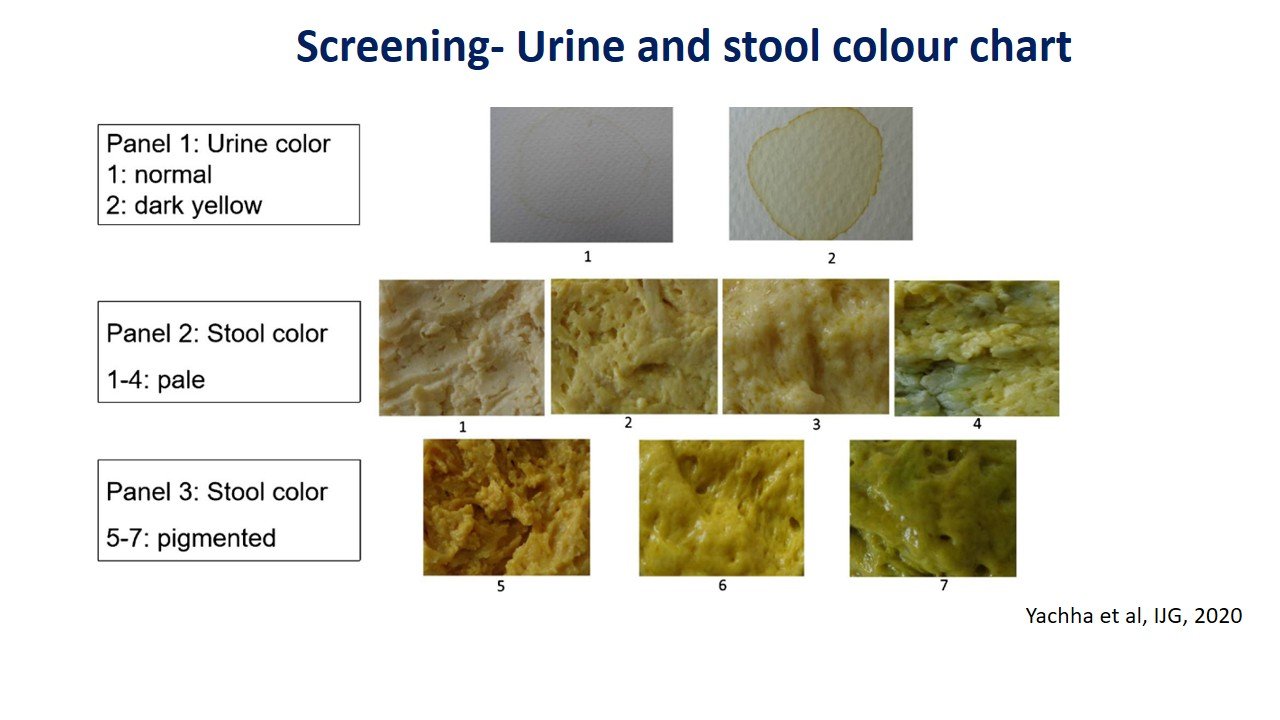
For screening, stool colour charts are available online and many institutes provide stool and urine colour chart to all the mothers after delivery to screen the babies for biliary atresia after birth. Stool colour charts are very easy to use, mothers just need to match the colour of baby’s stool in the chart (Pale stools in neonatal cholestasis). Japan and Taiwan have effectively used these screening methods.
The image below shows Stool colour chart for biliary atresia for early recognition of neonatal cholestasis. Adapted from Yachha et al., Indian J Gastroenterol, 2020
- Figure 1
Evaluation generally includes liver function tests, bilirubin levels, GGT level, ultrasound of the liver and biliary system, and other investigations to rule out alternative causes of neonatal cholestasis. Liver Biopsy remains the most important investigation before any intervention. HIDA scan is not much useful.
Gold standard to diagnose Biliary Atresia is percutaneous or operative cholangiography.
Because liver damage progresses with time, evaluation should be coordinated by a team experienced in pediatric hepatology and liver surgery.
How is biliary atresia treated? Is surgery needed for Biliary atresia?
The primary surgical treatment is the Kasai portoenterostomy which should be performed as early as possible.
During this procedure, the surgeon removes the scarred extrahepatic bile ducts and connects the intestine directly to the liver hilum, where microscopic bile ductules may still be present. The aim is to restore bile flow from the liver into the intestine. Restoring the bile flow slows down the progression of liver injury.
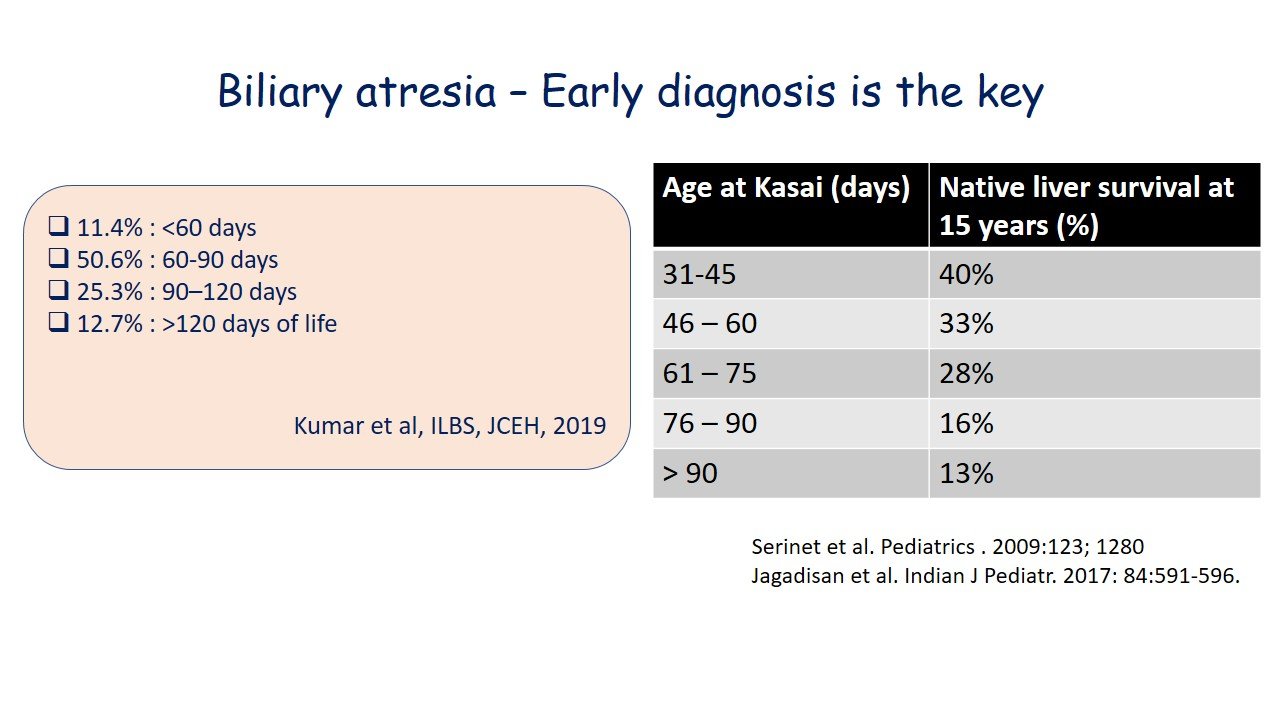
The timing of the Kasai procedure for biliary atresia matters. Earlier Kasai surgery is associated with better outcomes, with the best outcomes generally seen when surgery is performed within the first 30–45 days of life. Early surgery offers greater likelihood of establishing effective bile drainage, which is why prolonged observation of an infant with cholestatic jaundice can be dangerous. In Japan, surgeons perform Kasai surgery as early as 25-30 days of life. After 3 months, likelihood of getting good outcomes post Kasai surgery is very less.
The image below shows a slide that explains the surgical outcome based on age at which kasai surgery was done.
- Figure 2
Does every baby with biliary atresia need a liver transplant?
No. Not every baby requires an immediate liver transplant. The aim is to delay the need for transplant as long as possible. Some children do very well after Kasai surgery and can live for many years with their native liver without any liver related complication. However, biliary atresia may remain a progressive liver disease despite successful Kasai surgery, and some children may eventually develop complications such as cirrhosis, portal hypertension, recurrent cholangitis, poor growth or liver failure. Hence, these children are followed up regularly to look for any danger sign. For these children, liver transplantation can be a life-saving treatment.
Importantly, transplantation should not be viewed as a failure of Kasai surgery. In many children, Kasai provides valuable time with their native liver, while transplantation is performed later if significant liver disease develops.
The image below shows a 4 months old baby who underwent liver transplant for biliary atresia as Kasai surgery could not be done timely. Post-transplant baby is growing well and leading a healthy normal life under regular follow up of Dr Vipul Gautam.
- Figure 3

Fact- In India, delayed recognition and referral can result in some babies reaching specialist centres late, thereby missing the optimal window for Kasai surgery. In such babies, liver disease rapidly progresses and they often land up in decompensated cirrhosis requiring primary liver transplantation before completing first year of life.
What should parents remember?
One of the most important clues for parents is the colour of the baby’s stool. Pale, grey or white stools should never be ignored/missed in a jaundiced infant anytime after birth. Giving sunlight, using home remedies and delaying expert consultation, waste precious time as biliary atresia is a race against time.
Biliary atresia is uncommon, but missing the diagnosis can have serious consequences. Early recognition, timely referral to a pediatric hepatology team and appropriate surgical management can make a major difference. Dr. Vipul Gautam has extensive experience in managing children with biliary atresia, including more than 500 babies in clinical practice. Parents looking for a Pediatric Hepatologist in Vasant Kunj, Delhi can book a consultation at the Vasant Kunj clinic.
The image below shows children less than 2 years of age who underwent liver transplant under the care of Dr Vipul Gautam for biliary atresia. Three out of 5 of these babies had failed Kasai surgery and other 2 had primary liver transplant.
- Figure 4

What Does Our Published Research Show? (Research articles published by Dr Vipul Gautam in index journals mentioning biliary atresia)
These studies conducted by Dr Vipul Gautam answers scientifically with clinical experience that why early recognition of neonatal cholestasis matters?
- Biliary atresia: importance of early recognition and timely Kasai
Pediatric Liver Transplant is the standard of care for end-stage liver disease (ESLD) in children, with biliary atresia being the most prevalent cause worldwide.24 In our cohort, 40% of the pLT recipients had biliary atresia (with half being post-Kasai portoenterostomy). The lower rate of timely Kasai surgery is a major factor contributing to a higher num ber of infants requiring liver transplants at a younger age compared to those in developed countries.
Citation: Gautam V, Nekarakanti PK, Kumar V, et al. Long-term Prognosis in Pediatric Living Donor Liver Transplant Recipients Who Have Survived the First Year of Surgery. J Clin Exp Hepatol. 2025;15:102631. doi:10.1016/j.jceh.2025.102631.
2. When the diagnosis of biliary atresia remains uncertain: role of percutaneous cholangiography
The objective of this study was to evaluate the feasibility, safety, and diagnostic accuracy of percutaneous cholecystochol angiography (PCC) in cases of conjugated hyperbilirubinemia in which biliary atresia (BA) could not be diagnosed or ruled out based on clinical, radiological, and histopathological findings. This was a retrospective, chart review of all cholestatic infants who underwent PCC within the last 5 y. PCC was performed via the transhepatic route using 23-g needle. The patency of both the proximal and distal biliary trees was assessed. PCC was technically feasible in 12/13 (92.3%) of infants without any procedure-related complications. PCC demonstrated proximal and distal biliary patencyin 7/12 (58.3%) infants, thereby avoiding unnecessary laparotomy in them. PCC failed to demonstrate biliary patency in 5 infants; of which, 4 were confirmed as cases of BA on laparotomy. PCC can correctly differentiate BA from non-BA cases of conjugated hyperbilirubinemia preoperatively, reducing the negative laparotomy rates.
Citation: Ashritha A, Gautam V, Lal BB, et al. Percutaneous Cholecystocholangiography—A Tool to Conclusively Exclude Biliary Atresia. Indian J Pediatr. 2022;89(11):1144–1147. doi:10.1007/s12098-022-04354-2.
If your baby remains jaundiced after two weeks, especially if the stools are pale, speak to your pediatrician and ask whether a direct bilirubin test is needed and seek a pediatric hepatologist’s opinion for further management.
For more information on biliary atresia and parents’ counselling, Dr Vipul Gautam is routinely available at Vasant kunj Clinic and Max Hospital, Saket, New Delhi.
About the Author
Dr. Vipul Gautam, MD, DM
Consultant Pediatric Hepatologist & Pediatric Liver Transplant Physician
Centre for Liver and Biliary Sciences, Max Super Speciality Hospital, Saket, New Delhi
Private Clinic: Vasant Kunj, New Delhi
Clinic timings: Monday–Saturday, 7:00 AM–9:00 AM and 7:00 PM–9:00 PM
Sunday: By appointment
Areas of clinical interest: Pediatric gastroenterology, hepatology, neonatal cholestasis, biliary atresia and pediatric liver transplantation.
Last updated: September 2026